
Last week the Ninth Circuit ruled on the second of three first sale cases - MDY v. Blizzard. The opinion can be found here.
The case is about the use of bots (made by MDY) to assist in advancing in the World of Warcraft video game owned by Blizzard. For more facts about the case, see my previous blog entry.
Relying on the earlier decision in Vernor v. Autodesk, the first decision in the trio of first sale cases before the Ninth Circuit this term, the Court finds that the players of Blizzard are licensees and not owners of the World of Warcraft software. Blizzard’s World of Warcraft End User License Agreement specifically prohibits users from creating or using third party software to modify Worlds of Warcraft including bots.
However, the Ninth Circuit differentiates between a contract covenant which is a breach of the license agreement and not copyright enforceable conditions. Because the Ninth Circuit reversed the district court decision and determined that the MDY bot did not alter or copy any of Blizzard’s software, it was not a copyright enforceable condition and thus no copyright infringement occurred.
Next the Ninth Circuit had to decide whether MDY committed copyright infringement under the DMCA when it modified its bot to circumvent Blizzard’s Warden technology to prevent bots from connecting to the World of Warcraft servers.
In its interpretation of the DMCA (17 U.S.C. Section 1201(a)), the Court finds that the statute is meant to protect from circumvention of access controls to copyrighted works including decrypting and descrambling works. This does not necessarily affect the exclusive rights under Section 106 of the Copyright Act. The Court notes that this is a departure and differing view from the Chamberlain decision in the Federal Circuit requiring that the circumvention interfere with one of the exclusive rights under Section 106.
Based on this interpretation, the Court finds that MDY does not violate Section 1201(a)(2) for the literal elements and individual non-literal elements of Worlds of Warcraft because the Warden technology does not control access to the Worlds of Warcraft elements. The Warden technology does not prevent access to Worlds of Warcraft on an individual user’s computer but only to the Worlds of Warcraft servers.
However, the Court finds that MDY violates Section 1201(a) for the dynamic non-literal elements of Worlds of Warcraft. The Ninth Circuit explains the dynamic non-literal elements as analogous to the audiovisual display of a computer game which is independently copyrightable from the software program code. Because Warden does prevent access to the audiovisual display of the Worlds of Warcraft from its servers, MDY’s efforts to restructure its bots to circumvent the Warden technology is an infringement.
The Court reversed summary judgment for Blizzard for tortuous interference with contract because there were triable issues of fact.
Showing posts with label first sale doctrine. Show all posts
Showing posts with label first sale doctrine. Show all posts
Wednesday, December 22, 2010


Tuesday, December 21, 2010
Supreme Court Splits on First Sale
Last week the Supreme Court issued a split 4-4 ruling in the Costco v. Omega lawsuit. The opinion can be found here.
The split affirms the decision of the Ninth Circuit that the first sale doctrine does not apply to copyrighted works manufactured and sold abroad. The case has been reported in many news outlets, including the New York Times and Wall Street Journal.
The split affirms the decision of the Ninth Circuit that the first sale doctrine does not apply to copyrighted works manufactured and sold abroad. The case has been reported in many news outlets, including the New York Times and Wall Street Journal.
Thursday, November 11, 2010
Supreme Court Hearing on Copyright First Sale - November 8, 2010
I was in attendance at the Supreme Court on Monday, November 8, 2010 for the hearing in the Costco v. Omega matter. You can read the transcript of the hearing here.
It was interesting to hear the judge’s questions on the first sale doctrine and its applicability to copyrighted works made and distributed abroad.
A couple of non-substantive observations. (Disclosure: I have worked on this case on behalf of Omega from 2004 – present)
The outside of the courthouse is well-kept and architecturally stands out (even in Washington DC surrounded by other similar inspiring buildings including the Library of Congress, Capital Building and the Senate and House office buildings.
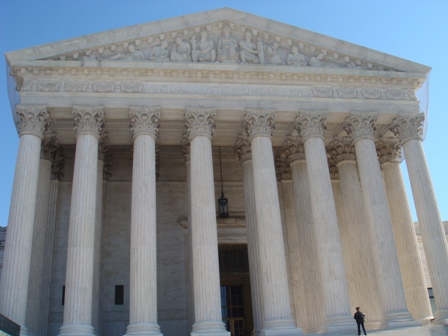
The building itself is celebrating its 75th Anniversary. The huge halls and columns inside are majestic but in some ways only lead up to disappointment once entering the courtroom itself. The courtroom is small. The seating capacity could not have been over 250 people. The vaulted ceilings may make everything seem small but there were relatively few rows of seats. (Some were bench type seating while chairs in rows and on ends of benches comprised the remainder of the seats.) I have been to circuit courts with more abundant seating.
The justices themselves were well prepared and were engaging with questions. Given the serious nature of Supreme Court proceedings in general, I was surprised that there were a couple of moments of laughter (where Justice Breyer indicated that even he had to draw the line somewhere and Justice Scalia quipped, "Let me write that down.").
Relatively speaking, the hour went by fairly quickly with three speakers, Aaron Panner for Respondent Omega, Roy Englert for Petitioner Costco, and Malcolm Stewart for the United States in support of Respondent.
A decision will be made before the end of June.

It was interesting to hear the judge’s questions on the first sale doctrine and its applicability to copyrighted works made and distributed abroad.
A couple of non-substantive observations. (Disclosure: I have worked on this case on behalf of Omega from 2004 – present)
The outside of the courthouse is well-kept and architecturally stands out (even in Washington DC surrounded by other similar inspiring buildings including the Library of Congress, Capital Building and the Senate and House office buildings.
The building itself is celebrating its 75th Anniversary. The huge halls and columns inside are majestic but in some ways only lead up to disappointment once entering the courtroom itself. The courtroom is small. The seating capacity could not have been over 250 people. The vaulted ceilings may make everything seem small but there were relatively few rows of seats. (Some were bench type seating while chairs in rows and on ends of benches comprised the remainder of the seats.) I have been to circuit courts with more abundant seating.
The justices themselves were well prepared and were engaging with questions. Given the serious nature of Supreme Court proceedings in general, I was surprised that there were a couple of moments of laughter (where Justice Breyer indicated that even he had to draw the line somewhere and Justice Scalia quipped, "Let me write that down.").
Relatively speaking, the hour went by fairly quickly with three speakers, Aaron Panner for Respondent Omega, Roy Englert for Petitioner Costco, and Malcolm Stewart for the United States in support of Respondent.
A decision will be made before the end of June.

Wednesday, September 29, 2010
BATTLES IN SEATTLE - Vernor v. Autodesk, Inc. Decision
A couple of months ago, Copyright Chronicle covered the 3 cases (UMG Recordings v. Augusto, Vernor v. Autodesk, Inc., and MDY Indus. v. Blizzard Entertainment) involving the first sale defense heard in Seattle by the Ninth Circuit in our First Sale Frenzy: Battles in Seattle series of posts.
The first decision has been made in the Ninth Circuit in the Vernor v. Autodesk case.
Procedural History/Summary: Vernor sold copies of Autodesk’s software on eBay. Autodesk filed several DMCA takedown notices with eBay. After several notices, Vernor’s account was suspended. Vernor filed a declaratory judgment action against Autodesk.
Autodesk alleged that it had licensed its software to CTA. Part of the license included that when updates were provided to its customers, they were to destroy the previous versions. However, CTA sold Version 14 to Vernor.
Autodesk was able to trace the software available on eBay to CTA. Autodesk maintained activation codes and serial numbers to verify registrations of its software. Portions of Autodesk’s agreements with its customers include use restrictions associated with the software.
The district court granted Vernor summary judgment finding that Vernor did not infringe on Autodesk’s software because Vernor was protected by the first sale defense under Section 109 and the essential step defense. The primary issue and question in the case was whether the transaction between Autodesk and CTA was a license or a sale. The first sale under Section 109 and the essential step defense do not apply to licenses but only to sales. The district court found that the transaction between Autodesk and CTA was a sale and therefore, Vernor was free to sell Version 14 on eBay. Vernor v. Autodesk, Inc., 2009 U.S. Dist. LEXIS 90906, *42-44 (W.D. Wash. 2009).
The case was appealed to the Ninth Circuit. The Court found the following factors relevant to the inquiry of whether a transaction is a license or a sale: (1) whether the copyright owner specifies that the user has a license; (2) whether the copyright owner significantly restricts the user’s ability to transfer the software; (3) whether the copyright owner places restrictions on use by the user. The Court found that the district court erred in finding that a sale occurs when a transferee is entitled to keep the work. Because Autodesk did not require a return of its work, the district court found there was a sale. Vernor v. Autodesk, Inc., 2010 U.S. App. LEXIS 18957, *25-26 (9th Cir. Wash., Sept. 10, 2010).
The Ninth Circuit reversed and remanded, holding that a software user is a licensee where the copyright owner: (1) specifies that the user is granted a license; (2) significantly restricts that user’s right to transfer the work; and (3) imposes restrictions on use. As these criteria were met in the transaction between Autodesk and CTA, Vernor was in the same position as CTA and had no right to sell Autodesk’s software. (CTA has previously settled with Autodesk.)
There were several amici involved in the case who had indicated that there were significant policy considerations; however, the Court found its ruling based on its precedent and Congress was free to amend or modify the law based on policy considerations. Vernor at *37.
The first decision has been made in the Ninth Circuit in the Vernor v. Autodesk case.
Procedural History/Summary: Vernor sold copies of Autodesk’s software on eBay. Autodesk filed several DMCA takedown notices with eBay. After several notices, Vernor’s account was suspended. Vernor filed a declaratory judgment action against Autodesk.
Autodesk alleged that it had licensed its software to CTA. Part of the license included that when updates were provided to its customers, they were to destroy the previous versions. However, CTA sold Version 14 to Vernor.
Autodesk was able to trace the software available on eBay to CTA. Autodesk maintained activation codes and serial numbers to verify registrations of its software. Portions of Autodesk’s agreements with its customers include use restrictions associated with the software.
The district court granted Vernor summary judgment finding that Vernor did not infringe on Autodesk’s software because Vernor was protected by the first sale defense under Section 109 and the essential step defense. The primary issue and question in the case was whether the transaction between Autodesk and CTA was a license or a sale. The first sale under Section 109 and the essential step defense do not apply to licenses but only to sales. The district court found that the transaction between Autodesk and CTA was a sale and therefore, Vernor was free to sell Version 14 on eBay. Vernor v. Autodesk, Inc., 2009 U.S. Dist. LEXIS 90906, *42-44 (W.D. Wash. 2009).
The case was appealed to the Ninth Circuit. The Court found the following factors relevant to the inquiry of whether a transaction is a license or a sale: (1) whether the copyright owner specifies that the user has a license; (2) whether the copyright owner significantly restricts the user’s ability to transfer the software; (3) whether the copyright owner places restrictions on use by the user. The Court found that the district court erred in finding that a sale occurs when a transferee is entitled to keep the work. Because Autodesk did not require a return of its work, the district court found there was a sale. Vernor v. Autodesk, Inc., 2010 U.S. App. LEXIS 18957, *25-26 (9th Cir. Wash., Sept. 10, 2010).
The Ninth Circuit reversed and remanded, holding that a software user is a licensee where the copyright owner: (1) specifies that the user is granted a license; (2) significantly restricts that user’s right to transfer the work; and (3) imposes restrictions on use. As these criteria were met in the transaction between Autodesk and CTA, Vernor was in the same position as CTA and had no right to sell Autodesk’s software. (CTA has previously settled with Autodesk.)
There were several amici involved in the case who had indicated that there were significant policy considerations; however, the Court found its ruling based on its precedent and Congress was free to amend or modify the law based on policy considerations. Vernor at *37.
Wednesday, June 16, 2010
BATTLES IN SEATTLE (Part 1 of 3)
In the copyright context, the determination of whether an individual or entity is a licensee rather than an owner of the copy can depend on the actions of the parties, despite contractual writings and notices. Whether an individual is an owner or a licensee can have an impact on the application of the copyright first sale doctrine.
On June 7, 2010, the Ninth Circuit panel sitting in Seattle, Washington heard oral arguments in UMG Recordings Inc. v. Augusto (a copyright first sale case about promotional sound recordings purchased at used music stores), Vernor v. Autodesk, Inc. (a copyright first sale case involving the sale of software on Ebay), and MDY Indus. v. Blizzard Entertainment (a copyright case related to software code in the computer game World of Warcraft).
With this trio of cases, the Ninth Circuit is presented with three different fact patterns. When considering these cases, the Court must determine, among other things, under what set of circumstances can a transaction be deemed a license and what constitutes a sale.
Copyright Chronicle will be covering each of these cases in a three part series over the next three days.
The parties are in their corners. Let’s get ready to RUMBLE!
Round 1 - UMG Recordings Inc. v. Augusto
On June 7, 2010, the Ninth Circuit panel sitting in Seattle, Washington heard oral arguments in UMG Recordings Inc. v. Augusto (a copyright first sale case about promotional sound recordings purchased at used music stores), Vernor v. Autodesk, Inc. (a copyright first sale case involving the sale of software on Ebay), and MDY Indus. v. Blizzard Entertainment (a copyright case related to software code in the computer game World of Warcraft).
With this trio of cases, the Ninth Circuit is presented with three different fact patterns. When considering these cases, the Court must determine, among other things, under what set of circumstances can a transaction be deemed a license and what constitutes a sale.
Copyright Chronicle will be covering each of these cases in a three part series over the next three days.
The parties are in their corners. Let’s get ready to RUMBLE!
Round 1 - UMG Recordings Inc. v. Augusto
Wednesday, May 12, 2010
Weekly Wednesday Wrapup - May 12, 2010
- FIRST SALE FRENZY: On June 7, 2010 the Ninth Circuit will hear appeals in UMG Recordings Inc. v. Augusto, a first sale case involving promotional sound recordings sold on Ebay; Vernor v. Autodesk, Inc., a first sale case involving software; and MDY Indus. V. Blizzard Entertainment, a first sale case involving software code in World of Warcraft video game.
- Google filed for declaratory judgment claiming DMCA protection claiming that Google timely removed and/or disabled links to Plaintiff’s DMCA takedown notice where Plaintiff, a record company alleged and filed a previous suit for contributory and vicarious copyright infringement when RapidShare links appeared in internet searches on Google and Microsoft search engines. Plaintiff previously contested that Google and Microsoft responded to the DMCA takedown letter. The case raises issues about responses to DMCA takedown notices as well as the boundaries of contributory and vicarious copyright infringement.
- In a case initially filed in the Southern District of New York and recently transferred to Central District of California, over 40 photographers, owners of photography copyrights and the organization that operates the San Diego Zoo are seeking more than $11 million in damages from the fast-food chain Taco Bell for copyright infringement.
Not one oral hearing on first sale doctrine but 3 – in the same day in the Ninth Circuit.
The Plaintiffs claim that 4 ecology-themed DVDs distributed along with Taco Bell’s “Kid’s Meal” menu items contained over 100 images that were used without authorization or compensation to the copyright owners. The subject images were licensed to SNAP TV Inc. by the wildlife-specialty stock photo agency Minden Pictures. The Complaint alleges that Minden has been unable to get SNAP TV to pay for its license and thus SNAP TV’s use of the images and by extension Taco Bell’s distribution of over 2 million DVDs containing these images constitutes copyright infringement.
Plaintiffs are seeking monetary damages as well as Taco Bell’s profits attributable to the alleged infringement. However, as the Complaint points out, these DVDs are promotional items which were distributed along with Taco Bell’s “Kid’s Meals” menu items. If the DVDs were given away for free, as is done with most Kid’s Meals at fast food chains, then there is not basis for computing profits attributable to their distribution—because there are none. Should they prevail upon their copyright claims, Plaintiffs may be better served by seeking statutory damages.
Subscribe to:
Posts (Atom)