
Following the decision that LimeWire’s peer file-sharing network infringed copyrights in a lawsuit filed by the Recording Industry Association of America, Judge Kimba Wood issued a permanent injunction against the company on October 26, 2010. The injunction was granted with LimeWire's consent.
In the 17 page order, the Court did go through the permanent injunction factors from the Salinger case in the Second Circuit. You can see the entire injunction here.
The Court found that LimeWire would be unlikely to be able to pay the statutory damage award. If LimeWire were not permanently enjoined, it would continue to facilitate “generations of infringement.” The RIAA would also be harmed because LimeWire would offer the copyrighted works that plaintiffs sell for free, thereby significantly affecting the market for the copyright owners’ works.
The Court also found the statutory damage award was not an adequate remedy at law especially to prevent future infringements and this factor favored a permanent injunction.
Because the Court found LimeWire’s business model was infringement, the balance of the hardships clearly favored plaintiffs. Finally the Court found that a permanent injunction serves the public interest by upholding copyrights and the harm caused by LimeWire.
In effect, LimeWire’s network has been shut down.
However, according to news reports, there is a software sharing program called LimeWire Pirate available on downloading sites on the Internet.
LimeWire has posted a notice on its website claiming it has recently become aware of third parties using the LimeWire name. The notice also includes a cease and desist to all parties using the LimeWire software, name and trademark.
Thursday, November 18, 2010


Thursday, November 11, 2010
Supreme Court Hearing on Copyright First Sale - November 8, 2010
I was in attendance at the Supreme Court on Monday, November 8, 2010 for the hearing in the Costco v. Omega matter. You can read the transcript of the hearing here.
It was interesting to hear the judge’s questions on the first sale doctrine and its applicability to copyrighted works made and distributed abroad.
A couple of non-substantive observations. (Disclosure: I have worked on this case on behalf of Omega from 2004 – present)
The outside of the courthouse is well-kept and architecturally stands out (even in Washington DC surrounded by other similar inspiring buildings including the Library of Congress, Capital Building and the Senate and House office buildings.
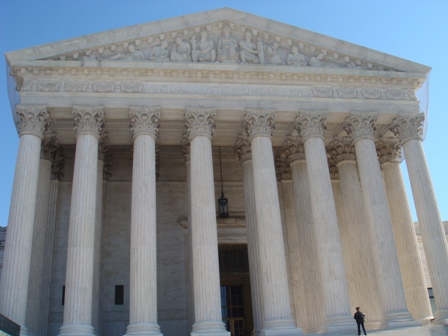
The building itself is celebrating its 75th Anniversary. The huge halls and columns inside are majestic but in some ways only lead up to disappointment once entering the courtroom itself. The courtroom is small. The seating capacity could not have been over 250 people. The vaulted ceilings may make everything seem small but there were relatively few rows of seats. (Some were bench type seating while chairs in rows and on ends of benches comprised the remainder of the seats.) I have been to circuit courts with more abundant seating.
The justices themselves were well prepared and were engaging with questions. Given the serious nature of Supreme Court proceedings in general, I was surprised that there were a couple of moments of laughter (where Justice Breyer indicated that even he had to draw the line somewhere and Justice Scalia quipped, "Let me write that down.").
Relatively speaking, the hour went by fairly quickly with three speakers, Aaron Panner for Respondent Omega, Roy Englert for Petitioner Costco, and Malcolm Stewart for the United States in support of Respondent.
A decision will be made before the end of June.

It was interesting to hear the judge’s questions on the first sale doctrine and its applicability to copyrighted works made and distributed abroad.
A couple of non-substantive observations. (Disclosure: I have worked on this case on behalf of Omega from 2004 – present)
The outside of the courthouse is well-kept and architecturally stands out (even in Washington DC surrounded by other similar inspiring buildings including the Library of Congress, Capital Building and the Senate and House office buildings.
The building itself is celebrating its 75th Anniversary. The huge halls and columns inside are majestic but in some ways only lead up to disappointment once entering the courtroom itself. The courtroom is small. The seating capacity could not have been over 250 people. The vaulted ceilings may make everything seem small but there were relatively few rows of seats. (Some were bench type seating while chairs in rows and on ends of benches comprised the remainder of the seats.) I have been to circuit courts with more abundant seating.
The justices themselves were well prepared and were engaging with questions. Given the serious nature of Supreme Court proceedings in general, I was surprised that there were a couple of moments of laughter (where Justice Breyer indicated that even he had to draw the line somewhere and Justice Scalia quipped, "Let me write that down.").
Relatively speaking, the hour went by fairly quickly with three speakers, Aaron Panner for Respondent Omega, Roy Englert for Petitioner Costco, and Malcolm Stewart for the United States in support of Respondent.
A decision will be made before the end of June.

Wednesday, November 3, 2010
Contributory Infringement or Settlement Negotiations?
On Saturday, Cablevision and NewsCorp, owner of the Fox television stations, settled their ongoing dispute over programming fees.
During the two week long battle, in which over 3 million Cablevision customers in the New York/Philiadelphia area were without News Corp's channels, Fox apparently sent a cease and desist letter to Cablevision accusing the company of copyright infringement.
Fox is accusing Cablevision of contributing or vicariously infringing on its copyrights by having the Cablevision service representatives advising its customers how to obtain content from Fox (and its other networks such as National Geographic Channel and Fox Business) via networks such as Ivi.
Ivi offers a subscription based service which delivers television live over the internet. Unlike websites such as Hulu, where someone can access episodes of previously aired shows, the Ivi player shows the original broadcast of whatever the television stations are airing at the time.
No specific companies were named in the letter, which can be seen here. However, Fox is part of a group of broadcasters, who include ABC, NBC, and CBS among others, who last month sued Ivi for copyright infringement. The case is WPIX Inc v. Ivi Inc, 10-7415, Southern District of New York.
Fox will likely need to show that Cablevision knew that it was inducing others to infringe on Fox’s copyrights. It may also need to show that Cablevision knew or instructed its customer services representatives to advise its customers how to obtain the programming.
Could the actions of Cablevision be further complicated if Cablevision was aware or received complaints about the Ivi website as either an Internet provider (unlikely due to the safe harbor provisions as currently interpreted by the Court in Viacom v. YouTube) or as a content provider themselves (Cablevision's subsidiary Rainbow Media Holdings owns such networks as AMC, IFC and the Sundance Channel)?
Was this a mere ploy by Fox to settle on more favorable terms? Could Cablevision bring a declaratory judgment action for a finding that it is not infringing on Fox’s rights? Now that an agreement has been reached by Fox and Cablevision, will Fox follow through or stop pursuing the claim for copyright infringment?
During the two week long battle, in which over 3 million Cablevision customers in the New York/Philiadelphia area were without News Corp's channels, Fox apparently sent a cease and desist letter to Cablevision accusing the company of copyright infringement.
Fox is accusing Cablevision of contributing or vicariously infringing on its copyrights by having the Cablevision service representatives advising its customers how to obtain content from Fox (and its other networks such as National Geographic Channel and Fox Business) via networks such as Ivi.
Ivi offers a subscription based service which delivers television live over the internet. Unlike websites such as Hulu, where someone can access episodes of previously aired shows, the Ivi player shows the original broadcast of whatever the television stations are airing at the time.
No specific companies were named in the letter, which can be seen here. However, Fox is part of a group of broadcasters, who include ABC, NBC, and CBS among others, who last month sued Ivi for copyright infringement. The case is WPIX Inc v. Ivi Inc, 10-7415, Southern District of New York.
Fox will likely need to show that Cablevision knew that it was inducing others to infringe on Fox’s copyrights. It may also need to show that Cablevision knew or instructed its customer services representatives to advise its customers how to obtain the programming.
Could the actions of Cablevision be further complicated if Cablevision was aware or received complaints about the Ivi website as either an Internet provider (unlikely due to the safe harbor provisions as currently interpreted by the Court in Viacom v. YouTube) or as a content provider themselves (Cablevision's subsidiary Rainbow Media Holdings owns such networks as AMC, IFC and the Sundance Channel)?
Was this a mere ploy by Fox to settle on more favorable terms? Could Cablevision bring a declaratory judgment action for a finding that it is not infringing on Fox’s rights? Now that an agreement has been reached by Fox and Cablevision, will Fox follow through or stop pursuing the claim for copyright infringment?
Thursday, October 28, 2010
Is Copying or Parody the Sincerest Form of Flattery?
A recent episode of South Park included a parody of the movie Inception. Normally a parody would be considered a fair use in terms of copyright. However, in this instance the creators of South Park claimed to have never seen the film. How was this discovered?
The South Park episode contained several quotes from a video that appeared on the website collegehumor.com. The video (which first appeared in August contained the line, “Sometimes my thoughts of my dead wife manifest themselves as trains.” The line never appeared in the movie Inception. However, the line was used, along with others from the web show, in the South Park episode, entitled 'Insheeption.'
The South Park creators have apologized to the collegehumor.com creators.
In the case of a parody defense to copyright infringement, the copying must be close so that the work can be recognized as a parody of the original work – however, it is a fine line – as a parody must only take what is necessary. This can be a very fact intensive process. See Campbell v. Acuff-Rose Music, Inc., 510 U.S. 569 (1994)
It is often difficult to determine when copying occurs. (In the instances of text, publishers will often print books with typographical errors to determine if someone has merely made a copy of its work.) Sometimes, the slightest changes will conceal whether a copyrighted work was in fact copied. Ideas and facts can often be expressed in many ways. However, because the South Park episode slavishly copied the collegehumor.com work, it was easy to tell where and what was copied.
The South Park episode contained several quotes from a video that appeared on the website collegehumor.com. The video (which first appeared in August contained the line, “Sometimes my thoughts of my dead wife manifest themselves as trains.” The line never appeared in the movie Inception. However, the line was used, along with others from the web show, in the South Park episode, entitled 'Insheeption.'
The South Park creators have apologized to the collegehumor.com creators.
In the case of a parody defense to copyright infringement, the copying must be close so that the work can be recognized as a parody of the original work – however, it is a fine line – as a parody must only take what is necessary. This can be a very fact intensive process. See Campbell v. Acuff-Rose Music, Inc., 510 U.S. 569 (1994)
It is often difficult to determine when copying occurs. (In the instances of text, publishers will often print books with typographical errors to determine if someone has merely made a copy of its work.) Sometimes, the slightest changes will conceal whether a copyrighted work was in fact copied. Ideas and facts can often be expressed in many ways. However, because the South Park episode slavishly copied the collegehumor.com work, it was easy to tell where and what was copied.
Monday, October 18, 2010
Privatizing U.S. Copyright Registrations?
Continuing on last week's discussion of the Copyright Principles Project, I am going to discuss one of the reform proposals being suggested by the CPP.
The CCP wants to make the copyright registration process more like the domain name registrar process. CPP: Directions for Reform, p. 26. Since many countries do not require a registration in the first place, I cannot see how this process would work. A decentralized registration process will only make copyrighted registrations more difficult to find. If you have ever tried to locate information regarding domain name registrations and owners, it is not an easy process. (In addition, some domain name registrars encourage and profit from the anonymity of its registration owners.)
There is also a more puzzling aspect – how and who would be in charge of managing copyright deposits. For obvious reasons, the Copyright Office does not post or make available online, a copy of the deposit for copyright applications. I do not believe that copyright registrars would post this information either. Therefore, all the registration would include is a title, author and possibly a description of the type of work.
The U.S. Copyright Office while often referring to itself as a record keeping office, must make some determinations on registration. It is nowhere near the rigorous standards of patent or trademark offices but a minimal review is required. It would be inappropriate for registrars to make determinations on whether the work itself is copyrightable.
There are a couple of organizational steps the Copyright Office could take. One example would be to better categorize the types of works. Broad categories such as sound recordings, performing arts, text and visual arts are somewhat helpful but today we have more definite descriptions that would make it more helpful in searching the copyright office records. Computer software programs, lyrics, musical compositions, websites, sculpture, paintings, architectural designs, etc. are better descriptions for others to search copyright records. (Titles themselves are not an accurate harbinger of what is contained in a deposit for a copyrighted work.)
While the CPP points out that it would also be advisable to have a sort of “small claims” procedure, it would be more than inappropriate to have separate registrars determine such claims. Copyright is a Constitutional principle:
Turning over decisions to determine rights to private registrars may not only result in conflicting results (such as in the instance of domain name registrations) but confusion. Besides the federal court system, a governmental agency such as the Copyright Office would be the only other appropriate way to decide such cases.
The CCP wants to make the copyright registration process more like the domain name registrar process. CPP: Directions for Reform, p. 26. Since many countries do not require a registration in the first place, I cannot see how this process would work. A decentralized registration process will only make copyrighted registrations more difficult to find. If you have ever tried to locate information regarding domain name registrations and owners, it is not an easy process. (In addition, some domain name registrars encourage and profit from the anonymity of its registration owners.)
There is also a more puzzling aspect – how and who would be in charge of managing copyright deposits. For obvious reasons, the Copyright Office does not post or make available online, a copy of the deposit for copyright applications. I do not believe that copyright registrars would post this information either. Therefore, all the registration would include is a title, author and possibly a description of the type of work.
The U.S. Copyright Office while often referring to itself as a record keeping office, must make some determinations on registration. It is nowhere near the rigorous standards of patent or trademark offices but a minimal review is required. It would be inappropriate for registrars to make determinations on whether the work itself is copyrightable.
There are a couple of organizational steps the Copyright Office could take. One example would be to better categorize the types of works. Broad categories such as sound recordings, performing arts, text and visual arts are somewhat helpful but today we have more definite descriptions that would make it more helpful in searching the copyright office records. Computer software programs, lyrics, musical compositions, websites, sculpture, paintings, architectural designs, etc. are better descriptions for others to search copyright records. (Titles themselves are not an accurate harbinger of what is contained in a deposit for a copyrighted work.)
While the CPP points out that it would also be advisable to have a sort of “small claims” procedure, it would be more than inappropriate to have separate registrars determine such claims. Copyright is a Constitutional principle:
"The Congress shall have power ... To promote the progress of science and useful arts, by securing for limited times to authors and inventors the exclusive right to their respective writings and discoveries." U.S. Constitution Article I Section 8.
Turning over decisions to determine rights to private registrars may not only result in conflicting results (such as in the instance of domain name registrations) but confusion. Besides the federal court system, a governmental agency such as the Copyright Office would be the only other appropriate way to decide such cases.
Tuesday, October 5, 2010
The Copyright Principles Project - Copyright Law Reform
The Copyright Principles Project: Directions for Reform is attempting to influence a movement to reform the current copyright law to be simpler, easier to understand the more malleable due to changing times. The report can be found here and will be published in the Berkeley Technology Law Journal this fall.
While I agree that the U.S. copyright law could use some revisions especially given technological advances, some of the ideas raised in the report are highly problematic.
First, in a practical sense, the U.S. copyright law has been amended well over 50 times in the past 30 years. 1 Patry on Copyright §§ 1:110-114 (2008).
This has not resulted in the law being able to keep up with the advances in technology. But viewed in terms of other areas of the law, copyright law manages to updated with regularity. The law will never be able to catch up with technology. By the time many laws are passed, new issues arise. It is unrealistic to believe that changes in the copyright law will cause it to catch up to the technology.
It is also inconsistent to believe that we can make copyright law simpler and easier to understand and at the same time catch up with technology. Technologies are complicated. The DMCA is an attempt by Congress to create a system of laws to apply copyright law to the digital age.
Striking a balance between creating an incentive for the creation and promotion of the arts and the rights of the public is not easy. Efforts by the Principles Project create imbalance for sake of ease.
For example, avoiding liability for non-commercial uses of a copyrighted work could make the law easier in terms of understanding what the law is; however, it takes the balance and weighs it heavily in favor of public rights and takes the rights of the author away. Courts have struggled with the problem of non-commercial uses especially under the fair use doctrine, but commercial/non-commercial uses are not the only factor. See e.g. Harper & Row Publishers, Inc. v. Nation Enterprises, 471 U.S. 539, 539 (1985).
The Principles Project has several other proposals including more “safe harbor” provisions, consistency in damage awards, and other provocative ideas which may the subject of future blog entries.
While I agree that the U.S. copyright law could use some revisions especially given technological advances, some of the ideas raised in the report are highly problematic.
First, in a practical sense, the U.S. copyright law has been amended well over 50 times in the past 30 years. 1 Patry on Copyright §§ 1:110-114 (2008).
This has not resulted in the law being able to keep up with the advances in technology. But viewed in terms of other areas of the law, copyright law manages to updated with regularity. The law will never be able to catch up with technology. By the time many laws are passed, new issues arise. It is unrealistic to believe that changes in the copyright law will cause it to catch up to the technology.
It is also inconsistent to believe that we can make copyright law simpler and easier to understand and at the same time catch up with technology. Technologies are complicated. The DMCA is an attempt by Congress to create a system of laws to apply copyright law to the digital age.
Striking a balance between creating an incentive for the creation and promotion of the arts and the rights of the public is not easy. Efforts by the Principles Project create imbalance for sake of ease.
For example, avoiding liability for non-commercial uses of a copyrighted work could make the law easier in terms of understanding what the law is; however, it takes the balance and weighs it heavily in favor of public rights and takes the rights of the author away. Courts have struggled with the problem of non-commercial uses especially under the fair use doctrine, but commercial/non-commercial uses are not the only factor. See e.g. Harper & Row Publishers, Inc. v. Nation Enterprises, 471 U.S. 539, 539 (1985).
The Principles Project has several other proposals including more “safe harbor” provisions, consistency in damage awards, and other provocative ideas which may the subject of future blog entries.
Wednesday, September 29, 2010
BATTLES IN SEATTLE - Vernor v. Autodesk, Inc. Decision
A couple of months ago, Copyright Chronicle covered the 3 cases (UMG Recordings v. Augusto, Vernor v. Autodesk, Inc., and MDY Indus. v. Blizzard Entertainment) involving the first sale defense heard in Seattle by the Ninth Circuit in our First Sale Frenzy: Battles in Seattle series of posts.
The first decision has been made in the Ninth Circuit in the Vernor v. Autodesk case.
Procedural History/Summary: Vernor sold copies of Autodesk’s software on eBay. Autodesk filed several DMCA takedown notices with eBay. After several notices, Vernor’s account was suspended. Vernor filed a declaratory judgment action against Autodesk.
Autodesk alleged that it had licensed its software to CTA. Part of the license included that when updates were provided to its customers, they were to destroy the previous versions. However, CTA sold Version 14 to Vernor.
Autodesk was able to trace the software available on eBay to CTA. Autodesk maintained activation codes and serial numbers to verify registrations of its software. Portions of Autodesk’s agreements with its customers include use restrictions associated with the software.
The district court granted Vernor summary judgment finding that Vernor did not infringe on Autodesk’s software because Vernor was protected by the first sale defense under Section 109 and the essential step defense. The primary issue and question in the case was whether the transaction between Autodesk and CTA was a license or a sale. The first sale under Section 109 and the essential step defense do not apply to licenses but only to sales. The district court found that the transaction between Autodesk and CTA was a sale and therefore, Vernor was free to sell Version 14 on eBay. Vernor v. Autodesk, Inc., 2009 U.S. Dist. LEXIS 90906, *42-44 (W.D. Wash. 2009).
The case was appealed to the Ninth Circuit. The Court found the following factors relevant to the inquiry of whether a transaction is a license or a sale: (1) whether the copyright owner specifies that the user has a license; (2) whether the copyright owner significantly restricts the user’s ability to transfer the software; (3) whether the copyright owner places restrictions on use by the user. The Court found that the district court erred in finding that a sale occurs when a transferee is entitled to keep the work. Because Autodesk did not require a return of its work, the district court found there was a sale. Vernor v. Autodesk, Inc., 2010 U.S. App. LEXIS 18957, *25-26 (9th Cir. Wash., Sept. 10, 2010).
The Ninth Circuit reversed and remanded, holding that a software user is a licensee where the copyright owner: (1) specifies that the user is granted a license; (2) significantly restricts that user’s right to transfer the work; and (3) imposes restrictions on use. As these criteria were met in the transaction between Autodesk and CTA, Vernor was in the same position as CTA and had no right to sell Autodesk’s software. (CTA has previously settled with Autodesk.)
There were several amici involved in the case who had indicated that there were significant policy considerations; however, the Court found its ruling based on its precedent and Congress was free to amend or modify the law based on policy considerations. Vernor at *37.
The first decision has been made in the Ninth Circuit in the Vernor v. Autodesk case.
Procedural History/Summary: Vernor sold copies of Autodesk’s software on eBay. Autodesk filed several DMCA takedown notices with eBay. After several notices, Vernor’s account was suspended. Vernor filed a declaratory judgment action against Autodesk.
Autodesk alleged that it had licensed its software to CTA. Part of the license included that when updates were provided to its customers, they were to destroy the previous versions. However, CTA sold Version 14 to Vernor.
Autodesk was able to trace the software available on eBay to CTA. Autodesk maintained activation codes and serial numbers to verify registrations of its software. Portions of Autodesk’s agreements with its customers include use restrictions associated with the software.
The district court granted Vernor summary judgment finding that Vernor did not infringe on Autodesk’s software because Vernor was protected by the first sale defense under Section 109 and the essential step defense. The primary issue and question in the case was whether the transaction between Autodesk and CTA was a license or a sale. The first sale under Section 109 and the essential step defense do not apply to licenses but only to sales. The district court found that the transaction between Autodesk and CTA was a sale and therefore, Vernor was free to sell Version 14 on eBay. Vernor v. Autodesk, Inc., 2009 U.S. Dist. LEXIS 90906, *42-44 (W.D. Wash. 2009).
The case was appealed to the Ninth Circuit. The Court found the following factors relevant to the inquiry of whether a transaction is a license or a sale: (1) whether the copyright owner specifies that the user has a license; (2) whether the copyright owner significantly restricts the user’s ability to transfer the software; (3) whether the copyright owner places restrictions on use by the user. The Court found that the district court erred in finding that a sale occurs when a transferee is entitled to keep the work. Because Autodesk did not require a return of its work, the district court found there was a sale. Vernor v. Autodesk, Inc., 2010 U.S. App. LEXIS 18957, *25-26 (9th Cir. Wash., Sept. 10, 2010).
The Ninth Circuit reversed and remanded, holding that a software user is a licensee where the copyright owner: (1) specifies that the user is granted a license; (2) significantly restricts that user’s right to transfer the work; and (3) imposes restrictions on use. As these criteria were met in the transaction between Autodesk and CTA, Vernor was in the same position as CTA and had no right to sell Autodesk’s software. (CTA has previously settled with Autodesk.)
There were several amici involved in the case who had indicated that there were significant policy considerations; however, the Court found its ruling based on its precedent and Congress was free to amend or modify the law based on policy considerations. Vernor at *37.
Subscribe to:
Posts (Atom)